
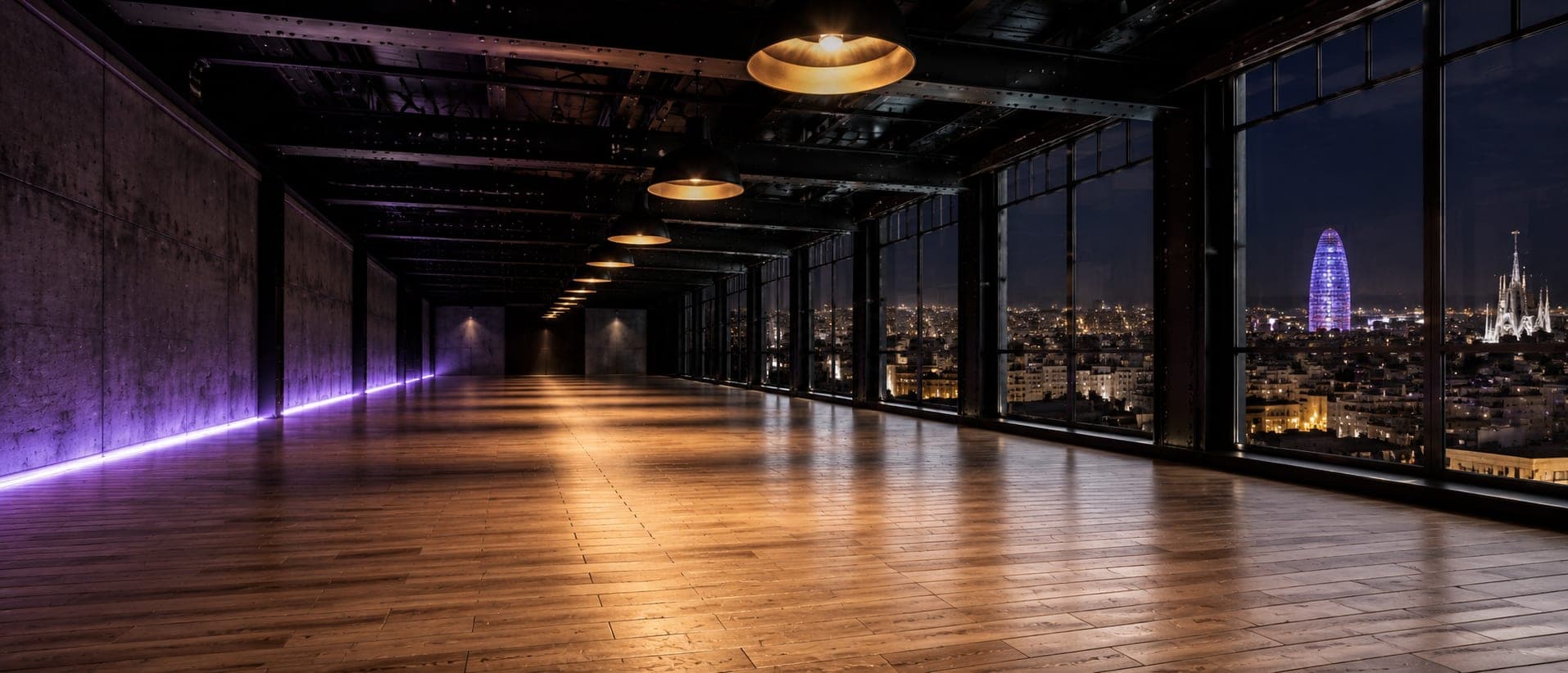
Choosing a venue for a corporate event in Barcelona is not just an aesthetic decision. The space determines what is logistically possible, shapes the catering options, limits or expands technical production possibilities, and has a direct effect on the total budget. Visiting a beautiful space without first defining the event parameters frequently leads to choosing the wrong venue.
Criteria first, then visits
Before visiting any space, it helps to be clear on capacity, format — seated dinner, cocktail, auditorium — whether there are activities requiring room to manoeuvre, whether the event runs by day or by night, and whether there are sound curfews. With those details in hand, shortlisting candidates becomes more efficient and site visits more productive.
Types of venue in Barcelona
Barcelona has a diverse offer: hotels with event rooms, repurposed industrial spaces, museums and cultural centres available for private hire, venues in the metropolitan area, and non-conventional spaces such as rooftops, warehouses, and former factories. Each type comes with different conditions regarding catering exclusivity, opening hours, installation possibilities, and included services.
Case study
BCG Barcelona 2022A corporate convention for Boston Consulting Group at La Pedrera in Barcelona, an example of a heritage venue adapted to demanding technical production.
Catering exclusivity: a critical variable
Some venues have in-house catering or work with exclusive suppliers. This can simplify coordination but also limits the ability to adjust price or menu. Other spaces allow external catering, which gives more flexibility. Before committing to a space, it is worth establishing whether the catering on offer aligns with the event's expectations.
Accessibility and arrival logistics
In Barcelona, location affects how attendees travel. A central space has public transport access but may have parking constraints. A peripheral space may require shuttle buses or private transport coordination. For events with delegations from multiple cities, the space most accessible from the airport or train stations has real logistical value.
Technical production: key questions to ask the venue
Not all venues have the same technical infrastructure. Worth asking:
- Does it have its own sound system, or does external equipment need to be brought in?
- Are there power restrictions for temporary installations?
- Can elements be rigged from the ceiling or existing structures?
- Is there accessible loading bay access for production vehicles?
- What is the rigging schedule before the event?
Visit the venue by day and by night
A space looks different depending on the light and the time of day. If the event runs at night, it is worth visiting the venue at night before signing, not only during office hours: interior lighting, ambient noise, and the overall feel of the space change completely. The same applies to season: an outdoor garden that works in June may not be viable in November without heating or additional cover, and that requirement feeds directly into the technical production budget.
Contract clauses worth reviewing
Beyond price, the venue contract includes conditions that directly affect production: cancellation policy and deadlines, penalties for exceeding the load-in or load-out schedule, required liability insurance, and restrictions on external suppliers. Heritage or protected venues usually have additional conditions on what can be fixed to walls or ceilings. Reviewing these clauses before signing avoids surprises that typically surface during load-in, when there is no longer room to change venue.
Venues outside central Barcelona
The offer is not limited to the city. The metropolitan area and the coast — Sitges, the Penedès, the Maresme — offer estates and spaces with more surface area and staging possibilities than the urban centre, in exchange for more complex transport logistics. For events with a strong experiential component, moving away from the city can reinforce the sense of a distinctive event, provided attendee transport is properly resolved in advance.
Case study
Louis Vuitton Summer PartyA gala dinner for Louis Vuitton at Masía Montcorp, Girona, an example of an out-of-city venue chosen for its natural setting and staging potential.
Flexibility around capacity changes
Capacity is one of the figures that changes most between booking the venue and the event date. A space that becomes too small if headcount rises by 20% is a risk. It is worth understanding how much flexibility the venue has in either direction before signing the contract.