
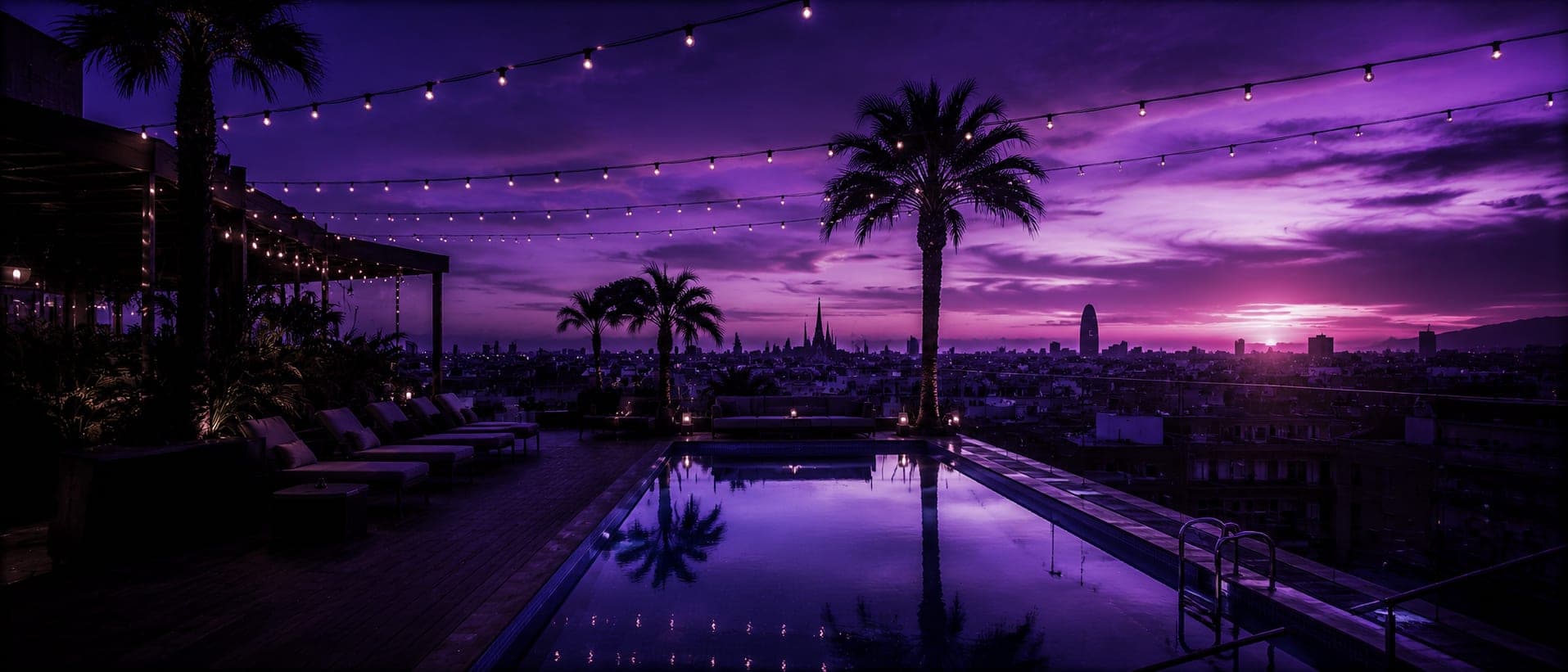
The summer party occupies its own place on the corporate events calendar: it lands at a point in the year without the symbolic weight of Christmas or the family constraints of the family day. It's almost always the most relaxed social event on the company calendar.
Outdoor venues, the default choice in Barcelona
Terraces, country estates with a pool, privatised beach bars or seafront venues are the most common options for a summer party in Barcelona. The evening light from June to September lets you schedule the event to start in natural daylight and end with the space lit artificially, with no need for complex lighting production.
How far in advance to book the venue
The most in-demand outdoor venues in Barcelona — estates with a pool, privatised beach bars, rooftops with views — receive most of their July and August enquiries between March and April of the same year. Booking four to five months ahead isn't overly cautious: it's what separates choosing among several strong options from settling for whatever's left a month out. The most requested venues tend to block out July Saturdays first, leaving weekdays or August as the fallback for anyone booking late, which also affects how many people can actually attend.
Timing shapes the tone
A summer party that starts mid-afternoon and is designed as a long, lingering meal has a different tone from one that starts at night straight into party mode. Neither is inherently better — it depends on whether you're after relaxed conversation or party energy from the start.
Open bar hours and how they set the pace
The number of open-bar hours affects the per-head budget more than almost any other element of the event, and it also sets the pace of the evening. An open bar running from the start in a standing cocktail format creates constant mixing between departments; a seated dinner with the bar opening once dancing starts keeps conversation concentrated at assigned tables early on and leaves spontaneous mixing for later. Neither format is better in the abstract — it depends on whether the goal is easier conversation between people who don't usually cross paths, or rewarding teams who already work together with a table of their own.
What sets it apart from the Christmas party
The Christmas party carries year-end expectations and often an element of recognition. The summer party has none of that weight — it's freer in format and doesn't need any institutional moment. Forcing a speech or an award into the summer party undermines exactly what makes it different: it's the party with no agenda.
Case study
Wallbox Attacks SummerA corporate summer festival for more than 1,000 Wallbox employees at Cavas Codorníu, with large-scale production for the year's flagship social event.
Case study
Louis Vuitton Summer PartyA summer gala dinner for Louis Vuitton at Masía Montcorp, in Girona — a summer party format built more around the elegance of the evening and the setting than around festival-style production.
Summer catering has its own rules
Catering designed for indoors doesn't always work well outdoors in the middle of summer: dishes that degrade in the heat, a bar service that can't keep up in high temperatures, or not enough shaded areas are common mistakes. A supplier with specific experience in outdoor summer events anticipates these problems before they show up on the day.
A backup plan for rain, even in summer
Summer storms in Barcelona are occasional but real, especially toward late August and in parts of the metropolitan area further from the coast. An outdoor venue with no covered alternative leaves the entire event exposed to whatever the weather does that day, with no room to manoeuvre if the forecast shifts at the last minute. Having a backup marquee or an adjoining indoor space, even if it never gets used, is the difference between calmly managing a change of plan and improvising a cancellation with guests already on their way.
Communicating the dress code in advance
A short line in the invitation stating whether a specific dress code is expected — or confirming the event is explicitly casual — avoids the awkwardness of guests turning up dressed for a work meeting at a party designed as an outdoor summer send-off. This detail matters especially at companies with offices in different cities, or with a very mixed workforce, where there's no shared unwritten rule about what to wear to a company social event.
A good summer party needs nothing more than a good venue, natural light used well, and no moment that sounds like a work meeting dressed up as a party.